Every post card in my collection has its own story. Every Wednesday I post one of the 3,000 plus stories.
Showing posts with label Texas. Show all posts
Wednesday, September 7, 2022
Going Home after Coming Home
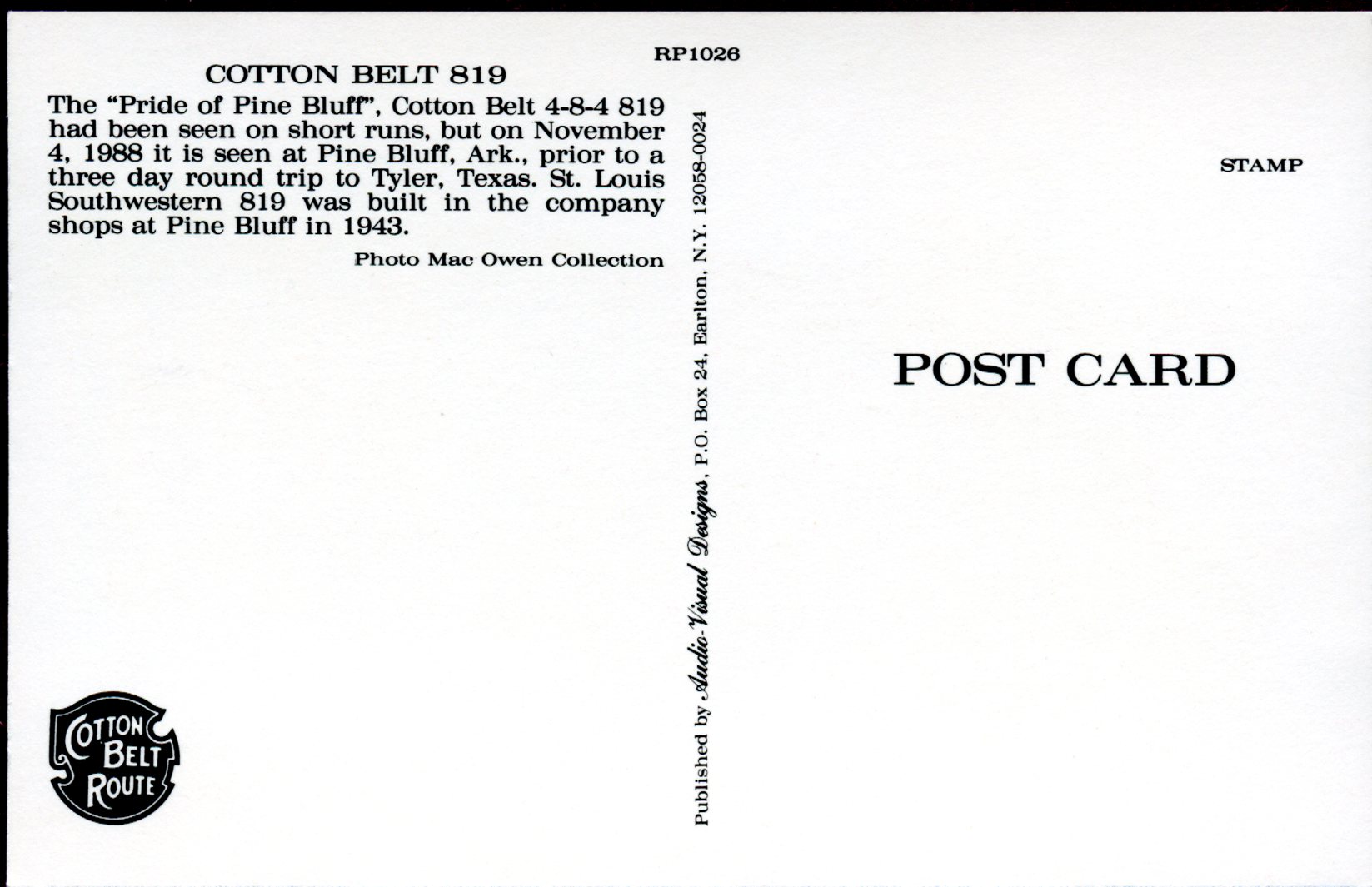
The locomotive shown here is a 4-8-4 Northern class engine, the “Pride of Pine Bluff”. In fact, it is in Pine Bluff, Arkansas on November 4, 1988 in this picture, prior to a three day round trip to Tyler Texas. This locomotive #819 was built in the shops here in Pine Bluff. It is coming home, so to speak, as it gets ready to go to the home of the Cotton Belt, Tyler, Texas.
Our good friends at Wikipedia tell us this: The St. Louis Southwestern Railway Company (reporting mark SSW), known by its nickname of "The Cotton Belt Route" or simply "Cotton Belt", is a former US Class I railroad which operated between St. Louis, Missouri, and various points in the states of Arkansas, Tennessee, Louisiana, and Texas from 1891 to 1980. In 1980 the Cotton Belt began operating the Rock Island's Golden State Route which added the states of Kansas, Oklahoma, and New Mexico to the operation. It operated as a Southern Pacific subsidiary from 1932 until the operation of the Cotton Belt was assumed by Southern Pacific Transportation Company in 1992.
What follows here is the history of the beginning and the end of the Cotton Belt Route with a list of all the railroads that have somehow been involved in the building of the railroad in between the beginning and the end. This history is taken from this website:
https://arkansasrailroadmuseum.org/about/cotton-belt-route.html#ewpopup/7/
Tyler Tap Railroad This was the first link in the St. Louis Southwestern Railroad (STLSW) Railroad in 1877 near Tyler Texas. The people of Tyler had hopes of being located on the main line of the International & Great Northern Railroad, but as it was surveyed to Longview by the way of Troup, the citizens decided to promote and construct a railroad to tap either the Texas & Pacific or the International. In charge of this scheme was a young army officer, Major James Postell Douglas. Upon returning home to East Texas after the War Between the States, Major Douglas became interested in the fruit industry. Needing a means of rapidly shipping this commodity outside the production area, he petitioned the Twelfth Legislature of Texas in 1870 to pass a special act of incorporation granting to him and others the right to locate, construct, own, operate, and maintain a railroad. It would own a single or double track for a distance not exceeding 40 miles from Tyler to connect with some other railroad, to be selected by the directors. His request was granted on December 1, 1871. This was a narrow-gauge line of 3 feet and operated with one small locomotive.
These railroads became part of the Cotton Belt over time: Texas & St. Louis Railway; St. Louis, Arkansas & Texas Railway; Little Rock and Shreveport Branches
Short Line Railroads Absorbed by Cotton Belt.
Little River Valley & Arkansas Railroad (Purchased 1881); Kansas & Gulf Short Line/Tyler; outheastern Railroads (Purchased 1899); Stuttgart & Arkansas River Railroad (Purchased 1901); Texas & Louisiana Railroad (Purchased 1903); Eastern Texas Railroad (Purchased 1906); Central Arkansas & Eastern Railroad (Leased 1910); Stephenville North & South Texas Railroad (Leased 1910); Paragould Southeastern Railroad (Purchased 1914); Pine Bluff Arkansas River Railroad (Leased 1918); The St. Francis Basin Project (1929-1930); Gideon & North Island Railroad; Deering Southwestern Railroad; Blytheville, Leachville & Arkansas Southern Railroad; Manila & Southwestern Railroad; Cairo, Truman & Southern Railroad; Arkansas Short Line Railroad; St. Louis Southwestern Railway
Southern Pacific Takes Control Since 1919 the Cotton Belt had been a very important connection of the Southern Pacific system on traffic between points in the East and the Pacific Coast and points in Texas. The consolidation and strengthening of other systems in the Southwest during the decade, 1920-1930, brought the Southern Pacific to a realization that self preservation required a route to this competitive territory. In July, 1930, the Southern Pacific filed an application with the Interstate Commerce Commission seeking authority to acquire control of the Cotton Belt. The final order of the ICC approved the plan upon conditions which the Southern Pacific accepted in February, 1932. On April 14, 1932, the Southern Pacific Company purchased the stocks which had been in escrow, and on April 19, the same year, it issued sufficient amounts of its own stock to exchange for deposited St. Louis Southwestern stocks in order to complete its control of the Cotton Belt. By May, 1933, the Southern Pacific had 193,134 shares of St. Louis Southwestern preferred and 130,834 shares of St. Louis Southwestern common or 87.37 per cent of the total outstanding shares of Cotton Belt stock. This is another of my Audio Visual Designs post cards. That is the Cotton Belt logo in the bottom left-hand corner of the post card.
Wednesday, July 13, 2022
Way, Way Up There!!!
The train on the front of this post card is crossing the Pecos River near where it meets the Rio Grande River in Texas. The train and railroad was originally owned by the Texas & New Orleans Railroad. This railroad, along with many of its own subidiaries, eventually became part of the Southern Pacific Railroad System. The following information was gleaned from a couple of sites on Wikipedia. The Texas and New Orleans Railroad was chartered as the Sabine and Galveston Bay Railroad and Lumber Company in 1856, and was formed to build a railroad from Madison (now Orange) in Orange County to tidewater at Galveston Bay. Ground breaking was on August 27, 1857 outside Houston and real construction work began in April, 1858. In late 1876 the railroad’ gauge was converted from 5 ft 6 in to standard gauge. In 1878 the Texas and New Orleans, Charles Morgan's Louisiana and Texas Railroad and Steamship Company, and the Louisiana Western Railroad Company reached an agreement and the line was finished from Orange to New Orleans. The Louisiana Western Extension Railroad Company was chartered in Texas to build from Orange to the Louisiana boundary and the first through train ran from Houston to New Orleans on August 30, 1880. 1881 C. P. Huntington, acting for the Southern Pacific Railroad Company, bought the Texas and New Orleans as well as many other railroads in the southern United States. As a result of this acquiring of railroads by Southern Pacific, The Texas and New Orleans Railroad found itself as part of a major transcontinental route. In 1882, The T&NO made over $1,500,000 and owned 36 locomotives as well as over 1000 pieces of rolling stock. Also in 1882 the T&NO acquired the 103-mile (166 km) Sabine and East Texas Railway Company. Many more companies were merged into T&NO from 1880 to 1900. In 1934 all of the railroads that the T&NO was leasing were merged into T&NO, making it the largest Texas railroad with 3,713 miles (5,975 km) of road (not all in Texas). On November 1, 1961 the remaining 3,385 miles (5,448 km) merged into the Southern Pacific and the T&NO ceased to exist.
Trains on the Sunset Route of the Southern Pacific lines have crossed the Pecos River on three different bridges, completed in 1883, 1892, and 1944. The most famous was the 1892 Pecos High Bridge, for many years the highest railroad bridge in North America. On the original Sunset Route, completed in 1883, a low bridge was located at the mouth of the Pecos River, where it joins the Rio Grande. To reach this crossing, trains between Comstock and Langtry had to follow a winding route called the Loop Line, which descended southward down steep grades into the canyons of the Rio Grande, passed through two tunnels and deep cuts, and ran along ledges where the danger of rock slides was constant. In 1892 the Pecos crossing was moved northward five miles upstream from the junction with the Rio Grande, in order to eliminate the Loop Line and shorten the rail distance between San Antonio and El Paso by eleven miles. The new line reached the Pecos at a point where the river flows through a deep gorge. The Pecos High Bridge was built there in only eighty-seven working days, between November 3, 1891, and February 20, 1892. Some colorful legends of Judge Roy Bean date from these days, when he served as coroner after construction accidents. The first train to cross the bridge was a special carrying C. P. Huntington, president of the Southern Pacific, on March 30, 1892.
The 1892 high bridge was built by the Phoenix Bridge Company of Phoenixville, Pennsylvania, and was of the metal viaduct style with cantilever center sections. It was supported by twenty-four towers and had a total length of 2,180 feet. The rails stood 321 feet above the river. The bridge was thus the highest railroad bridge in North America and the third highest in the world (exceeded only by the 401-foot Garabit Viaduct in France, built in 1884, and the 336-foot Loa Viaduct in Bolivia, built in 1889). For many years it was a tradition for trains to pause near the bridge and proceed slowly so that passengers could view the canyon, the landmark bridge, and the river below. In 1909 and 1910 the structure was significantly reinforced, the original four-leg central towers were converted to six-leg towers, and the length was reduced to 1,516 feet by a filled embankment at the west end. Additional reinforcement was added in 1929. Finally, with the increased rail traffic during World War II, it became clear that a new, heavier structure was needed.
Construction was begun in August 1943 at a site 440 feet downstream from the 1892 bridge. The 1892 bridge was dismantled in 1949, with sections sold to highway departments and local governments in several states. The back of the post card tells us that part of the bridge is used to cross the Wabash River in the state of Indiana. The post card as rounded corners; not very many of the post cards in my collection do. It was published by Kustom Quality out of El Paso, Texas. I know it was published after 1963 because there is a zip code included in the company's address. It is still in existence today, although they don't have a website.
Wednesday, April 6, 2022
The Brothers loved steam.
The information below was taken 100% from this website: https://donsdepot.donrossgroup.net/dr1104.htm
The Moscow, Camden and San Augustine Railroad Company was chartered on May 18, 1898, by William Thomas and Ernest A. Carter, who owned the W. T. Carter and Brother Lumber Company. The railroad was planned to connect Moscow in Polk County with San Augustine fifty miles to the east. The capital was $250,000, and the principal place of business was Camden. The line from Moscow to Camden, a distance of seven miles, was built for the railroad by the lumber company in 1899. W. T. Carter moved his operations to Camden where he had extensive timber holdings after a fire destroyed his sawmill at Barnum in 1897. The railroad connected the mill with the Houston East and West Texas Railway Company at Moscow. Although chartered to run as far east as San Augustine, the company only extended a short distance east of Camden where it intersected a tram line that brought logs from Camp Ruby. This connection formed a Y, which allowed the locomotives to be turned. The Moscow, Camden and San Augustine quickly paid for itself as it returned $56,500 in dividends during the first twenty years. Only $9,000 was paid out as cash dividends, the balance was a transfer from surplus in the profit and loss account to the credit of the open account with the various stockholders. This discharged their indebtedness for unpaid subscriptions. Due to the close relation of the railroad to the W. T. Carter and Brother Lumber Company, locals suggested that the initials on the side of the locomotive tender stood for "Mr. Carter and Sid Adams," the owner and long-time superintendent, respectively, of the sawmill. The Moscow, Camden and San Augustine never owned much rolling stock; for much of its history it only had one or two locomotives and a combination baggage-coach with space for express, passengers, and a desk for the conductor. Freight traffic, originally lumber from the sawmill, and later supplemented by pulp wood or wood chips, was carried in cars provided by its connecting railroad. In 1903 the railroad reported passenger earnings of $500 and freight earnings of $15,000. By 1952 the amounts were $100 and $50,000, respectively. The railroad had an interesting operation at Moscow. The train was left on a hill outside of town while the locomotive was uncoupled and turned on a turntable for the return trip. Once this was done, the brakes were released on the cars which then coasted into a siding at the depot. This practice ended in April 1959 when the railroad leased a locomotive that was too large for the turntable. Instead of being turned at Moscow, it ran forward from Camden to Moscow and backed up on the return trip. Passenger service on the Moscow, Camden and San Augustine increased in the late 1950s, when a ride on the railroad's mixed freight and passenger train became somewhat of a tourist attraction. The railroad was also the last common carrier in Texas to use steam locomotives in regular service, but after 1965 only diesel engines were in use. Passenger revenues peaked in the early 1970s and were nearly $2,800 in 1972. However, passenger service was discontinued in July 1973 due to the age of the combine used to carry passengers, which dated from 1898, and the fear of potential accidents at the busy Highway 59 crossing near Moscow. In 1968 the Carter family sold the sawmill, the timber lands, and railroad to what was then United States Plywood-Champions Paper, Incorporated. The railroad remains an active subsidiary of that company now known as Champion International, Incorporated. The post card was published by the same company as last week's post card.
Tuesday, February 27, 2018
So Much Going on 110 Years Ago
I know. I know. The first thing you noticed is that there is no train in this train post card. You are absolutely right! And, I have several other post cards that do not have a train engine in them. I was attracted to this one because it is a beautiful depot. Plus, it was mailed before March 1, 1907. "Why March 1, 1907?" you ask. Because after that date people could actually legally write the message on the other side of the card, next to the address. The person who mailed this post card missed that date by two days. This is one of the very last post cards to be mailed according to the post office rules that forbade writing a message on the reverse side.
But, those two reasons aren't enough. When you read the message, you understand that this is one of the last times we will see a post card with that picture on the front. The message says, "Feb 26 '07. Hello Mother. This building burned to the ground today. Will write you soon. Chas." It is a sad occasion because this train station, The Sunset Depot, was built by the Southern Pacific Railroad and opened on July 31, 1903. It was only 3 and a half years old.
This is the back of the post card: It is addressed to Charles' mother who lived in Portland, Texas. Portland is on the gulf of Mexico and San Antonio is 150 miles away, almost straight north, in the interior of the state.
The post card was printed and published by Raphael Tuck & Sons. If you look carefully, you will see a seal in the upper left corner of the post card. This is proof that Raphael Tuck & Sons are official Art Publishers to their majesties the king and queen of England. Not an easy gig to achieve. Their own logo is the little blob in the lower left of the post card. This information about the company comes from the Metropolitan Postcard Club of New York's website. http://www.metropostcard.com/ This Company was founded in 1866 by Raphael Tuck, a seller of furniture, pictures, and frames. In 1871, after concentrating on the picture side of the business, Tuck’s three sons joined the firm and they began printing their first Christmas cards. When Raphael retired in 1881, his son Adolph took over the family business. By 1894, a year after they were appointed official printers to Queen Victoria, they printed their first Souvenir Card. When postal regulations were finally changed after much lobbying by Tuck and others, it provided better opportunities to enter the postcard market. Tuck immediately began the printing of postcards in chromolithography, and their twelve card set of London became the first illustrated card set in England. By 1899 they became the first publisher to print postcards in a larger size, what we now call standard. They went on to publish a very wide variety of card types and printed matter, including many innovative designs, eventually becoming a major publishing house. Not one to miss an opportunity, Tuck also became a major supplier of postcard accessories such as albums and display frames for cards.
But, those two reasons aren't enough. When you read the message, you understand that this is one of the last times we will see a post card with that picture on the front. The message says, "Feb 26 '07. Hello Mother. This building burned to the ground today. Will write you soon. Chas." It is a sad occasion because this train station, The Sunset Depot, was built by the Southern Pacific Railroad and opened on July 31, 1903. It was only 3 and a half years old.
This is the back of the post card: It is addressed to Charles' mother who lived in Portland, Texas. Portland is on the gulf of Mexico and San Antonio is 150 miles away, almost straight north, in the interior of the state.
The post card was printed and published by Raphael Tuck & Sons. If you look carefully, you will see a seal in the upper left corner of the post card. This is proof that Raphael Tuck & Sons are official Art Publishers to their majesties the king and queen of England. Not an easy gig to achieve. Their own logo is the little blob in the lower left of the post card. This information about the company comes from the Metropolitan Postcard Club of New York's website. http://www.metropostcard.com/ This Company was founded in 1866 by Raphael Tuck, a seller of furniture, pictures, and frames. In 1871, after concentrating on the picture side of the business, Tuck’s three sons joined the firm and they began printing their first Christmas cards. When Raphael retired in 1881, his son Adolph took over the family business. By 1894, a year after they were appointed official printers to Queen Victoria, they printed their first Souvenir Card. When postal regulations were finally changed after much lobbying by Tuck and others, it provided better opportunities to enter the postcard market. Tuck immediately began the printing of postcards in chromolithography, and their twelve card set of London became the first illustrated card set in England. By 1899 they became the first publisher to print postcards in a larger size, what we now call standard. They went on to publish a very wide variety of card types and printed matter, including many innovative designs, eventually becoming a major publishing house. Not one to miss an opportunity, Tuck also became a major supplier of postcard accessories such as albums and display frames for cards.
Subscribe to:
Posts (Atom)