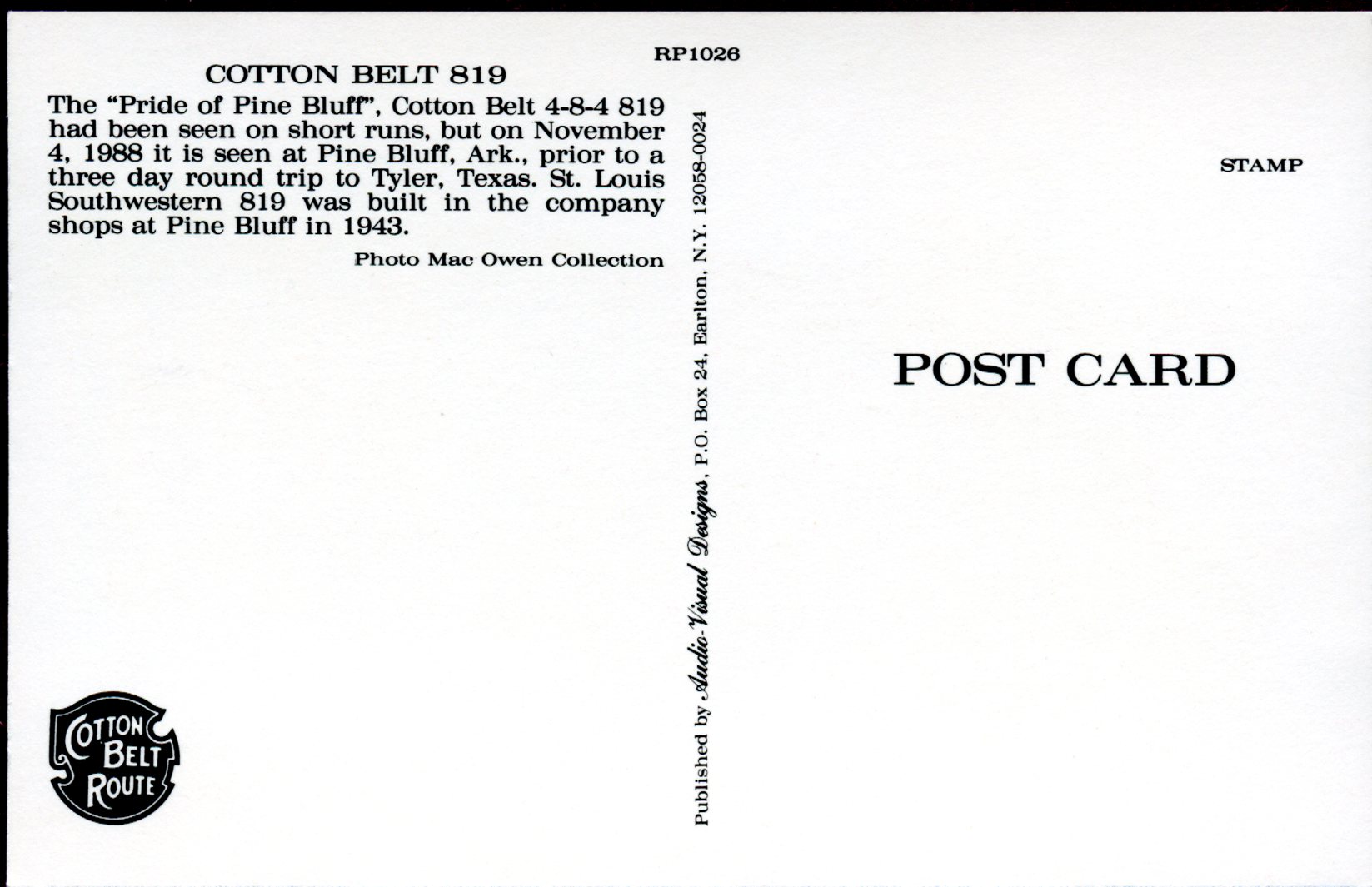
The locomotive shown here is a 4-8-4 Northern class engine, the “Pride of Pine Bluff”. In fact, it is in Pine Bluff, Arkansas on November 4, 1988 in this picture, prior to a three day round trip to Tyler Texas. This locomotive #819 was built in the shops here in Pine Bluff. It is coming home, so to speak, as it gets ready to go to the home of the Cotton Belt, Tyler, Texas.
Our good friends at Wikipedia tell us this: The St. Louis Southwestern Railway Company (reporting mark SSW), known by its nickname of "The Cotton Belt Route" or simply "Cotton Belt", is a former US Class I railroad which operated between St. Louis, Missouri, and various points in the states of Arkansas, Tennessee, Louisiana, and Texas from 1891 to 1980.
In 1980 the Cotton Belt began operating the Rock Island's Golden State Route which added the states of Kansas, Oklahoma, and New Mexico to the operation. It operated as a Southern Pacific subsidiary from 1932 until the operation of the Cotton Belt was assumed by Southern Pacific Transportation Company in 1992.
What follows here is the history of the beginning and the end of the Cotton Belt Route with a list of all the railroads that have somehow been involved in the building of the railroad in between the beginning and the end. This history is taken from this website:
https://arkansasrailroadmuseum.org/about/cotton-belt-route.html#ewpopup/7/
Tyler Tap Railroad This was the first link in the St. Louis Southwestern Railroad (STLSW) Railroad in 1877 near Tyler Texas. The people of Tyler had hopes of being located on the main line of the International & Great Northern Railroad, but as it was surveyed to Longview by the way of Troup, the citizens decided to promote and construct a railroad to tap either the Texas & Pacific or the International. In charge of this scheme was a young army officer, Major James Postell Douglas. Upon returning home to East Texas after the War Between the States, Major Douglas became interested in the fruit industry. Needing a means of rapidly shipping this commodity outside the production area, he petitioned the Twelfth Legislature of Texas in 1870 to pass a special act of incorporation granting to him and others the right to locate, construct, own, operate, and maintain a railroad. It would own a single or double track for a distance not exceeding 40 miles from Tyler to connect with some other railroad, to be selected by the directors. His request was granted on December 1, 1871. This was a narrow-gauge line of 3 feet and operated with one small locomotive.
These railroads became part of the Cotton Belt over time: Texas & St. Louis Railway; St. Louis, Arkansas & Texas Railway; Little Rock and Shreveport Branches
Short Line Railroads Absorbed by Cotton Belt.
Little River Valley & Arkansas Railroad (Purchased 1881); Kansas & Gulf Short Line/Tyler; outheastern Railroads (Purchased 1899); Stuttgart & Arkansas River Railroad (Purchased 1901); Texas & Louisiana Railroad (Purchased 1903); Eastern Texas Railroad (Purchased 1906); Central Arkansas & Eastern Railroad (Leased 1910); Stephenville North & South Texas Railroad (Leased 1910); Paragould Southeastern Railroad (Purchased 1914); Pine Bluff Arkansas River Railroad (Leased 1918); The St. Francis Basin Project (1929-1930); Gideon & North Island Railroad; Deering Southwestern Railroad; Blytheville, Leachville & Arkansas Southern Railroad; Manila & Southwestern Railroad; Cairo, Truman & Southern Railroad; Arkansas Short Line Railroad; St. Louis Southwestern Railway
Southern Pacific Takes Control Since 1919 the Cotton Belt had been a very important connection of the Southern Pacific system on traffic between points in the East and the Pacific Coast and points in Texas. The consolidation and strengthening of other systems in the Southwest during the decade, 1920-1930, brought the Southern Pacific to a realization that self preservation required a route to this competitive territory. In July, 1930, the Southern Pacific filed an application with the Interstate Commerce Commission seeking authority to acquire control of the Cotton Belt. The final order of the ICC approved the plan upon conditions which the Southern Pacific accepted in February, 1932. On April 14, 1932, the Southern Pacific Company purchased the stocks which had been in escrow, and on April 19, the same year, it issued sufficient amounts of its own stock to exchange for deposited St. Louis Southwestern stocks in order to complete its control of the Cotton Belt. By May, 1933, the Southern Pacific had 193,134 shares of St. Louis Southwestern preferred and 130,834 shares of St. Louis Southwestern common or 87.37 per cent of the total outstanding shares of Cotton Belt stock. 
This is another of my Audio Visual Designs post cards. That is the Cotton Belt logo in the bottom left-hand corner of the post card.