Showing posts with label Ohio. Show all posts

Wednesday, March 18, 2026

Bigger than Ever!!

The locomotives pictured on the front of this post card are the products of Alco, the American Locomotive Company.
The back of the post card reads: “Three of Genesee & Wyoming Railroad’s Alco 1,000 h.p. locomotives, Numbers 35, 1776, and 42 are shown entering Genesee & Wyoming’s Retsof Freight Yard in Retsof, N.Y. These Units are normally NU’s in order to provide the necessary power to transport salt trains from Retsof to the Caledonia, N.Y. interchange location.” My favourite website about the history of railroads, https://www.american-rails.com/gw.html tells us this: The history of G&W;'s current operations began humbly as a small, short-line by the same name, the Genesee & Wyoming Railroad. This little system was based in Western New York, south of Rochester and began as the Genesee & Wyoming Valley Railway. The G&WV; was incorporated in 1891 and eventually opened from Retsof (where the picture on the front of this post card was taken) to a location known as P&L; Junction near Caledonia in 1894, a distance of about 14 miles. With freight traffic never materializing as hoped the G&WV fell into bankruptcy in November of 1898 and was reorganized as the Genesee & Wyoming Railroad (reporting mark GNWR), incorporated on March 24, 1899. The new G&W was owned by Edward Laton Fuller and began serving a massive salt mine near Retsof, owned by the International Salt Corporation. The mine was, for many years, the largest producer of rock salt in the world and the G&W's largest customer. As it turns out salt remained the railroad's primary source of traffic throughout the 1970s and even today it continues to handle large quantities of the mineral. The modern history of the G&W is continued on the American Rails website. I recommend that you go there to read about it. It leads to the information contained on the current website of the G&W. You can read that and more here: https://www.gwrr.com/about-us/ Genesee & Wyoming Inc. (G&W) owns or leases more than 100 freight railroads throughout North America with 4,000 employees serving 2,000 customers over more than 13,000 track miles. G&W subsidiaries and joint ventures also provide rail service at more than 30 major ports, rail-ferry service between the U.S. Southeast and Mexico, transload services, and railcar switching and repair.
This post card is another of Mary Jayne’s Railroad Specialties post cards in my collection. The photo was taken by Thomas Cottone.

Wednesday, March 11, 2026

The Bluebird of Happiness - for a Train Fan!!

The locomotive pictured on the front of this post card is an Alco S4 Switcher.
This one is just minutes out of Grand Rapids on the bridge that spans the Maumee River and the Miami-Erie Canal. The train ride on the Bluebird Passenger Train passes the historic Ludwig Mill and is great family fun, entertainment and an exciting educational experience, according to the back of the post card. This website: https://tlew.org/ provides the information regarding the Bluebird Passenger Train. This museum runs the train. Today the Toledo, Lake Erie & Western Railway and Museum (TLE&W) hosts the Bluebird Passenger Train. The museum is a nonprofit, volunteer-run organization dedicated to preserving Northwest Ohio’s railroad heritage. Established in 1965 and incorporated in 1969, it operates on a 10-mile stretch of historic track between Waterville and Grand Rapids, Ohio, originally part of the Toledo, St. Louis and Western Railroad (aka Clover Leaf, later Nickel Plate Road and Norfolk & Western). The museum showcases vintage locomotives, railcars, and equipment, offering visitors a glimpse into the region’s rail history. Its signature Bluebird Passenger Train, though currently not running due to track restoration, is a focal point of ongoing volunteer efforts. The TLE&W also features a scenic 901-foot bridge over the Maumee River, the largest owned by a tourist railroad east of the Mississippi. In 2014, the museum expanded by acquiring the Waterfront Electric Railway Museum in Grand Rapids, enhancing its historical displays and community engagement.
This post card is another of the 243 post cards in my collection from Mary Jayne’s Railroad Specialties. This one was published in March of 1999. The photo was taken by Joe Minnich.

Wednesday, January 15, 2025

Still around and still going strong; the Railroad, not the locomotive, that is.

The locomotive on the front of this post card is a 2-8-4 Berkshire that has
stopped to take on water in Dillonvale, Ohio on June 16, 1955, on the Nickel Plate Railroad. However, the locomotive was originally purchased by the Wheeling & Lake Erie Railway. That company has gone through quite a few changes, but it still exists today. Here is a history of the railway as taken from their website: https://www.wlerwy.com/ The Wheeling & Lake Erie Railway Company is the largest Ohio-based railroad and among the largest regional railroads in the country. Our service area includes 840 miles of track operating in Ohio, Pennsylvania, West Virginia and Maryland. 1871 Began in order to fulfill the need for a railroad connection between the Wheeling, West Virginia coal fields and Lake Erie port cities and facilities. Initial enthusiasm was offset by capital constraints. 1877 Interest intensifies in transporting Ohio coal to Lake Erie and iron ore from the Lake to steel plants in southeast Ohio. 1913 Main offices were moved to Brewster, Ohio, where they remain today. 1945 W&LE changes hands several times after World War II, leased by Nickel Plate, then controlled by Norfolk & Western, which later merged to become Norfolk Southern. 1990 Norfolk Southern sold W&LE to a group of investors, who renewed the Wheeling & Lake Erie Railway corporate name. The new rail system was now made up of a combination of the former W&LE, the Pittsburgh & West Virginia (PWV) and the Akron, Canton & Youngstown (ACY) lines. The 576 miles of track, combined with trackage rights encompassed 840 miles. 1994 W&LE acquired the former Akron and Barberton Belt Railroad and part of the local Conrail “Cluster” railroad in the greater Akron, Ohio area. A wholly owned subsidiary of The Wheeling Corporation, the Akron Barberton Cluster Railway handles in excess of 10,000 carloads per year for our 25 customers, primarily consisting of traffic in aggregates, chemicals, grain, plastic products, and scrap iron. Today W&LE now handles over 140,000 carloads per year and operates in Ohio, Pennsylvania, West Virginia, and Maryland. The company is private, 100% internally owned, and currently has approximately 425 employees. The post card was published by Audio Visual Designs out of Earlton, New York. AVD was started in 1964 by Carl Sturner for the sole purpose of providing railfans with sound recordings of locos and trains as well as with photochrome postcards of trackside photos. These stunning color images were taken all over the country by some well-known photographers such as David Sweetland. This photo on today’s post card was taken by Bob Collins. The history and product line of AVD can be found on the company's website at www.audiovisualdesigns.com

Saturday, August 22, 2015

Following the Rabbit Trails...


Colette and I won a trip to Los Angeles through a radio station that we listen to and support. We stayed in a hotel in the financial district about 6 or 8 blocks from the Union Train Station. Across the street from the hotel was the enticing little Caravan Book Store. It had displays in the windows and inside the store, itself that screamed at me, “Come visit!” So we did. We met a nice gentleman who directed me to the train section of the bookstore. It included a few groupings of post cards. As I thumbed through them I realized that I already had most of them in my collection. He even had some Byron Harmon post cards from the Canadian Rockies near Field, British Columbia. We had a discussion about trains and I bought two post cards from his collection to add to mine.
This is one of them. I was attracted to it for two reasons; first, it had a train on the front and, second, it was from Lima, Ohio. My paternal grandfather was born in Lima, Ohio.
I have researched the train station. There were five stations in Lima, but I cannot figure out which one was known as the Union Depot. I found this in Wikipedia: Allen County's first railroad line was built by the Indiana Railroad in 1854 and later subsumed into the Pennsylvania Railroad system. By the early twentieth century, Lima was a transportation center with links to five railroads, and its economy was highly dependent on the industry-leading Lima Locomotive Works.
Then I tried to find out about the publisher: the M. Weixelbaum Co.
Searching the web I found that there have been many Weixelbaums in the United States. The closest I could come to this company was the following. This is the result of me putting together many puzzle pieces; I am not sure of exactly how accurate the picture is, but, here goes… M. Weixelbaum was born on June 19, 1883 as Milton Weixelbaum the son of Jewish parents Adolph and Jennie. He had at least one brother, probably Jesse. Milton married Elnora Betz in 1912; they had no children by 1926. He must have either gone into business with his brother(s) or they inherited the business. In the local paper there is a reference to applying for a job at the Weixelbaum Brothers Co. 20 West High Street.
I found things published by him as early as 1906. They were post cards of Muncie, Indiana. This particular post card is from the Divided Back Era (1907 – 1915). I can date it even more specifically because the postmark on the back says that the card was mailed on August 20, 1910. That makes this post card 105 years old two days ago.

Saturday, June 27, 2015

Where the Heck is Ashtabula?

This post card shows a train crossing the bridge (not the bridge in the story immediately following) over the Ashtabula River at Ashtabula, Ohio, a city in Ohio northeast of Cleveland. The name Ashtabula comes from ashtepihele, which means 'always enough fish to be shared around' in the Lenape language. (You can find out more about the Lanape Indians here: www.lenapelifeways.org)
It was a major location on the Underground Railroad in the middle 19th century. There is an article about one of the houses in Ashtabula at this website: www.nps.gov/nr/travel/underground/oh8.htm

It was also the sight of the Ashtabula River Railroad Disaster. This was a derailment caused by the failure of a bridge (not the one pictured in the post card, and not this railroad company) over the Ashtabula River about 1,000 feet from the railroad station.

On December 29, 1876, at about 7:30 pm, two locomotives hauling, in tandem, 11 railcars of the Lake Shore and Michigan Southern Railway carrying 159 passengers plunged into the river in deep snow when the bridge gave way beneath them. The wooden cars were set alight by their heating stoves. The accident killed ninety-two people and was the worst rail accident in the U.S. until the Great Train Wreck of 1918. The coroner's report found that the bridge, designed by the railroad company president (William Henry Vanderbilt), had been improperly designed and inadequately inspected. As a result of the accident a hospital was built in the town and a federal system set up to formally investigate fatal railroad accidents.

The train travelling across the bridge belonged to the New York, Chicago and St. Louis Railroad, more commonly known as The Nickel Plate Road. It existed from 1881 to 1964, when it was absorbed into the Norfolk Western Railroad, just before it was merged into the Norfolk Southern Railroad in 1982. Numerous legends have grown about when and how the name "Nickel Plate" was first applied. The accepted version is that it appeared first in an article in the Norwalk, Ohio, Chronicle of March 10, 1881. On that date the Chronicle reported the arrival of a party of engineers to make a survey for the "great New York and St. Louis double track, nickel plated railroad." Later, while attempting to induce the company to build the line through Norwalk instead of Bellevue, Ohio, the Chronicle again referred to the road as "nickel plated" - a term regarded as indicative of the project's glittering prospects and substantial financial backing. In 1882, the Nickel Plate recognized F.R. Loomis, owner and editor of the Norwalk Chronicle, as originator of the term and issued him Complimentary Pass No. 1. Thus Norwalk named the road - but Bellevue finally got it. The preceding came from Wikipedia.
The post card was printed by one of my favorite post card printers. This man and his company were innovative and prolific in the production of post cards. I have written about Curt Otto Teich a few times in the past blogs. The best description is in the blog dated November 13, 2012. I go into quite a bit of detail about him and his company. The Curt Teich logo on this post card appears here to the bottom right of these words:
The number on the post card is R-90907. It appears just above the P in POST CARD. Given what we know about his numbering system, this would place the printing of this post card in the first quarter of the year 1918. He used the R or an A with a number from 1 to 124180 between the years 1908 to 1922. Using a bit of mathematics we arrive at the time line above for the printing of this particular post card. It also places the printing of the post card in the White Border Era; so, I feel good dating the card about 1918 or thereabouts.

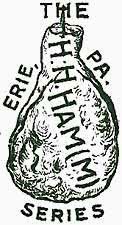
The post card was published by Harry H. Hamm of Toledo, Ohio - the other side of the state from Ashtabula. I could not find anything about Harry Hamm of Toledo, Ohio, but the Metropolitan Postcard Club shows us that there was a Harry Harmm of Erie, Pennsylvania. Here is the great logo that appeared on the cards he printed from Erie.
He published from there in the years 1907 - 1923. I wonder out loud if he didn't have a branch office in Toledo... This post card is from the White Border Era (1915 - 1930). It is quite possible that he moved from Erie to Toledo for the last seven years of this era, too. This is the logo that the Harry H. Hamm of Toledo used on his post cards.
I think I prefer the creativity and fun in the first logo!!