Showing posts with label Nickel Plate RR. Show all posts

Wednesday, February 1, 2023

Another Nickel Plate Locomotive

The locomotive pictured on the front of this post card was built by Lima in 1944 – very close to the end of the steam era of railroads. Here it is viewed
near Sheldon, Illinois on May 7, 1980 with a freight train of the Toledo, Peoria & Western. It picked up the consist in Effner, Indiana and it is bound for East Peoria, Illinois. But, this is no regular revenue run. This locomotive has been restored. It was on static display and is now operable. Read on…the information below was taken from this website: https://fortwaynerailroad.org/about/ The Fort Wayne Railroad Historical Society, Inc. (FWRHS) is an award-winning, 501(c)3 non-profit corporation founded in 1972. The organization has over 800 members, 100 volunteers, nine board of directors and a number of project managers. In 1974, the Society was successful in removing historic Nickel Plate Road steam locomotive no. 765 from display in Lawton Part in Fort Wayne, Indiana. That is the locomotive whose photo appears on the front of this post card. In 1979, the FWRHS became the first all volunteer, non-profit organization to successfully restore and operate a steam locomotive, writing a significant chapter in the early days of the country’s rail preservation movement. Since 1980, the Society has hosted and administered passenger train excursions, private charters, public exhibitions and education outreach activities with the 765 and a variety of other vintage railroad equipment throughout the Midwest. The locomotive and its train continue to serve as an uncommon cultural attraction with worldwide appeal, offering tourists, passengers and supporters from all 50 states and numerous countries the opportunity to relive a bygone era of innovation in American history. The Society holds regular work sessions and open houses at its restoration facility in New Haven, Indiana during the year and is poised to become a major player in downtown Fort Wayne as part of the Headwaters Junction attraction – all within a mile of the park where the 765 was initially preserved for display.
The post card was published by Mary Jayne’s Railroad Specialties, Inc. I have written about Mary Jayne in the past. I never get tired of telling people what a great correspondence I had with her when I was trying to see if she printed a catalogue of the train post cards that she published. She did; and she sent it to me for free! She only asked that I give some money to charity or to my church. The picture on the front was taken by Russ Porter. My research tells me that he was born on November 5, 1918 and died on October 24, 2001. He was a prolific railroad photographer.

Wednesday, January 25, 2023

Chicago to New York in Style

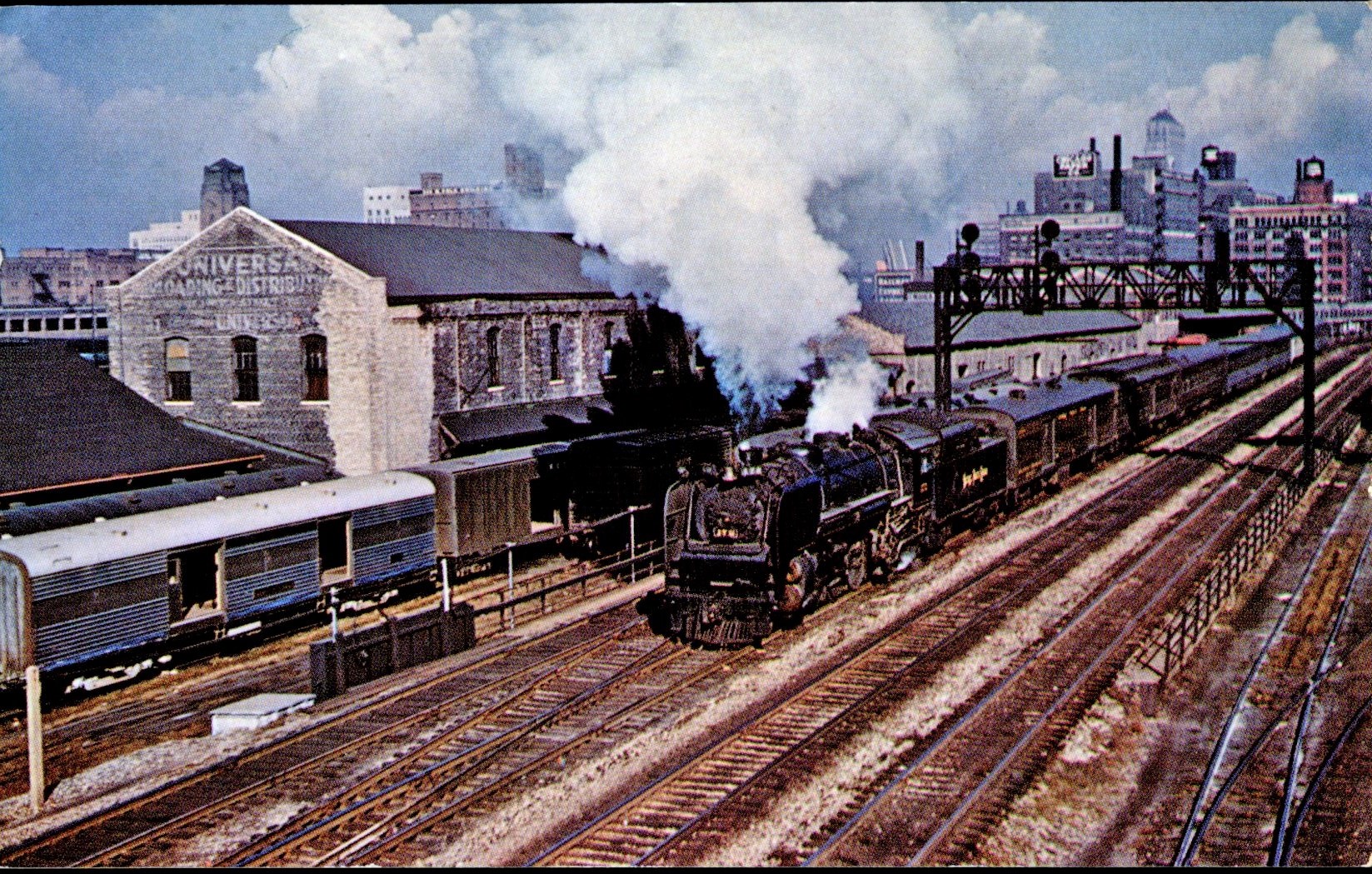
The locomotive in the picture on the front of this post card is Nickel Plate Number 172. It is pulling train Number 8 from Chicago to New York. It is
departing Chicago here on October 14, 1955. The following information was taken from these two websites: https://en.wikipedia.org/wiki/Nickel_Plate_Road and https://www.american-rails.com/nickel.html Its 2,200-mile network linked Buffalo with Chicago and St. Louis within the hotly contested Midwestern market while the late-era addition of the Wheeling & Lake Erie provided significant coal and steel traffic. It was built to impeccably high standards with a physical plant capable of high-speed service that shined in the post-World War II era. As a result, all three trunk lines (Pennsylvania, New York Central, and Baltimore & Ohio) occasionally shifted their own trains (including flagship services) onto the Nickel Plate. It did so well, in fact, that according to John Rehor's excellent book, "The Nickel Plate Story," the company grossed $2.8 billion between 1945 and the 1964 merger with Norfolk & Western while enjoying profits of $250 million. Today, many of the Nickel Plate's primary corridors remain in use under successor Norfolk Southern. The Nickel Plate Limited was a passenger night train operated by the New York, Chicago and St. Louis Railroad (Nickel Plate) between Chicago and Buffalo, New York via Cleveland, Ohio, with through service to Hoboken, New Jersey (for New York City) via Binghamton and Scranton and the Delaware, Lackawanna and Western Railroad for the Buffalo-Hoboken segment. In 1954 the Nickel Plate renamed the train: the westbound train became the City of Chicago while the eastbound train became the City of Cleveland. Service to Hoboken ended in 1959. Both trains survived the Nickel Plate itself: service ended on September 10, 1965, a year after the Nickel Plate's 1964 merger with the Norfolk and Western Railway. They were the final remnants of the Nickel Plate's passenger service.
This post card was published by Audio-Visual Designs our of Earlton, New York. It was published between 1955 and 1963. I know this because the picture was taken in 1955 and the address of Audio-Vidual Designs does not include a zip code. Zip codes were introduced in the United States in 1963.

Saturday, June 27, 2015

Where the Heck is Ashtabula?

This post card shows a train crossing the bridge (not the bridge in the story immediately following) over the Ashtabula River at Ashtabula, Ohio, a city in Ohio northeast of Cleveland. The name Ashtabula comes from ashtepihele, which means 'always enough fish to be shared around' in the Lenape language. (You can find out more about the Lanape Indians here: www.lenapelifeways.org)
It was a major location on the Underground Railroad in the middle 19th century. There is an article about one of the houses in Ashtabula at this website: www.nps.gov/nr/travel/underground/oh8.htm

It was also the sight of the Ashtabula River Railroad Disaster. This was a derailment caused by the failure of a bridge (not the one pictured in the post card, and not this railroad company) over the Ashtabula River about 1,000 feet from the railroad station.

On December 29, 1876, at about 7:30 pm, two locomotives hauling, in tandem, 11 railcars of the Lake Shore and Michigan Southern Railway carrying 159 passengers plunged into the river in deep snow when the bridge gave way beneath them. The wooden cars were set alight by their heating stoves. The accident killed ninety-two people and was the worst rail accident in the U.S. until the Great Train Wreck of 1918. The coroner's report found that the bridge, designed by the railroad company president (William Henry Vanderbilt), had been improperly designed and inadequately inspected. As a result of the accident a hospital was built in the town and a federal system set up to formally investigate fatal railroad accidents.

The train travelling across the bridge belonged to the New York, Chicago and St. Louis Railroad, more commonly known as The Nickel Plate Road. It existed from 1881 to 1964, when it was absorbed into the Norfolk Western Railroad, just before it was merged into the Norfolk Southern Railroad in 1982. Numerous legends have grown about when and how the name "Nickel Plate" was first applied. The accepted version is that it appeared first in an article in the Norwalk, Ohio, Chronicle of March 10, 1881. On that date the Chronicle reported the arrival of a party of engineers to make a survey for the "great New York and St. Louis double track, nickel plated railroad." Later, while attempting to induce the company to build the line through Norwalk instead of Bellevue, Ohio, the Chronicle again referred to the road as "nickel plated" - a term regarded as indicative of the project's glittering prospects and substantial financial backing. In 1882, the Nickel Plate recognized F.R. Loomis, owner and editor of the Norwalk Chronicle, as originator of the term and issued him Complimentary Pass No. 1. Thus Norwalk named the road - but Bellevue finally got it. The preceding came from Wikipedia.
The post card was printed by one of my favorite post card printers. This man and his company were innovative and prolific in the production of post cards. I have written about Curt Otto Teich a few times in the past blogs. The best description is in the blog dated November 13, 2012. I go into quite a bit of detail about him and his company. The Curt Teich logo on this post card appears here to the bottom right of these words:
The number on the post card is R-90907. It appears just above the P in POST CARD. Given what we know about his numbering system, this would place the printing of this post card in the first quarter of the year 1918. He used the R or an A with a number from 1 to 124180 between the years 1908 to 1922. Using a bit of mathematics we arrive at the time line above for the printing of this particular post card. It also places the printing of the post card in the White Border Era; so, I feel good dating the card about 1918 or thereabouts.

The post card was published by Harry H. Hamm of Toledo, Ohio - the other side of the state from Ashtabula. I could not find anything about Harry Hamm of Toledo, Ohio, but the Metropolitan Postcard Club shows us that there was a Harry Harmm of Erie, Pennsylvania. Here is the great logo that appeared on the cards he printed from Erie.
He published from there in the years 1907 - 1923. I wonder out loud if he didn't have a branch office in Toledo... This post card is from the White Border Era (1915 - 1930). It is quite possible that he moved from Erie to Toledo for the last seven years of this era, too. This is the logo that the Harry H. Hamm of Toledo used on his post cards.
I think I prefer the creativity and fun in the first logo!!