Wednesday, February 28, 2024

Really Not Sure About this One

The train on the front of this post card is traveling on what is called the "Pan Bowl". There is a spot on the North Fork of the Kentucky River near Jackson, Kentucky where the river made a very large "Oxbow". (An oxbow is a u-shaped bend in the course of a river.) You can see the same river (North Fork of the Kentucky River) on each side of the locomotive in this picture. For the water to travel from one side of the locomotive to the other, it will have to travel a loop that is 7 miles long. I guess that the people living in the area call this a "Pan Bowl" rather than an oxbow. This scene does not exist like this any more.
The river's course was shortened by that 7 mile loop when the state built State Highway Number 15 (on the map it is called Park Road). They dammed the river and formed a lake that they appropriately called "Panbowl Lake". It is advertised as a beautiful lake with lots of game fishing because of its depth. All this happens near Jackson, Kentucky. Here is a map to show where it is in relation to Jackson. But, you can also see the oxbow that was dammed to form the lake.
The post card was published by the Kyle Company (1915 - 1920) out of Louisville, Kentucky. It was printed by Curt Otto Teich's company.

Wednesday, February 21, 2024

Getting Ready to Retire

The front of this post card shows a locomotive with only three more years left in its life. The words on the back of the post card say, “Pennsylvania 713. 0-4-0 No. 713, Pennsylvania RR Class A5s, travels down the street in Atlantic City, NJ, April 25, 1954. Forty-seven locomotives of this class were turned out by the Pennsy’s Juniata Shops.” I researched both the A5s locomotives and the Juniata Shops. Here are the results. The Pennsylvania Railroad's class A5s was the largest class of 0-4-0 steam locomotives. The Pennsylvania Railroad built 47 in its Juniata Shops between 1916–1924. They were all retired by 1957. One is preserved at the Railroad Museum of Pennsylvania The information below is a combination materials gleaned from Wikipedia and this website: https://www.nps.gov/parkhistory/online_books/railroad/shs1c.htm#:~:text=The%20Pennsylvania%20Railroad%20began%20the%20construction%20of%20a,1952%2C%20this%20structure%20became%20the%20diesel%20engine%20shop. In the 1920s many railroads in the United States of America had retired 0-4-0 steam locomotives, because they were too small for switching duties. This was not the case on the Pennsylvania Railroad. The Pennsylvania Railroad was keen on this wheel arrangement due to complex street and tight industrial trackage across its broad network. For some of these lines, the Pennsylvania Railroad needed a large 0-4-0 to handle the larger switching activities the railroad had. Although the class B was designated for steam locomotives with the 0-6-0 wheel arrangement, these steam locomotives could not fit the tight and complex street, dockyard and industrial trackage the Pennsylvania Railroad had in its possession. As early as 1948, the A5s steam locomotives started to be replaced by higher horse powered and heavy-duty diesel switchers. Over the next year, these switchers were gradually replaced by diesel locomotives. Finally in 1957, the Pennsylvania Railroad converted from steam to diesel power and the end of an era was finished. The Pennsylvania Railroad began the construction of a second machine shop at Juniata in 1917. This structure, completed in 1918, served as a tank shop to repair and construct locomotive tenders. The Juniata shops contained two blacksmith shops, boiler shop, two machine shops, tank shop, two welfare buildings, and an erecting and machine shop. These shops constructed and repaired locomotives with more than 4,200 people working there. These shops could repair four locomotives a day and build twelve locomotives a month. By 1922, various railroad shops and departments occupied fifty acres and were housed in hundreds of buildings. The work force, during this time, varied from between 15,000 to 16,000 people. The Pennsylvania Railroad expanded the Juniata Works in 1924 and 1925 by construction of a fifty-stall erecting and machine shop at the east end of the existing shops along with a three-story storehouse and a small flue shop. This all was part of an effort to move the locomotive works away from the area of the Altoona machine shops around Twelfth Street. This is another of the 333 Audio-Visual Designs Publishing Company post cards that are in my collection.

Wednesday, February 14, 2024

A Man of Determination Did This!

The bridge featured on the front of this post card is located 85 kilometers south of St. Augustine. It is on the Florida East Coast Railway line.
It is part of a rail empire built by a man who had no interest in railroads per se. Henry Flagler just wanted to improve the transportation system along “The American Riviera”, as he called it. He had retired (he was a founding member of Standard Oil) and wanted to get to St. Augustine to enjoy the sunshine. This website has a great, detailed description of the history of the Florida East Coast Railway.https://www.american-rails.com/fecry.html The modern Florida East Coast began with Flagler's acquisition of the Jacksonville, St. Augustine & Halifax River Railway. This narrow-gauge property started it all for the oil mogul. During the winter of 1883-1884, a 53 year-old retired Flagler spent vacation in historic St. Augustine, Florida. Flagler was appalled at the lack of transportation services into the region. Jacksonville was the furthest one could travel directly by rail; there was another 65 kilometers to go to get to St. Augustine. To reach St. Augustine, a hamlet of only 2,500 residents, one must board a steamboat to cross the St. Johns River and then catch a train on the narrow-gauge Jacksonville, St. Augustine & Halifax River Railway. Flagler purchased this railway on December 31, 1885. He purchased several other railroads to help to connect the two dots. On January 20, 1890 a bridge was completed across the St. Johns River establishing direct service into Jacksonville. On September 9, 1895 Flagler's railroads became collectively known as the Florida East Coast Railway. Following the Florida East Coast Railway's creation, Flagler continued his southward push reaching New Smyrna Beach in 1892, Cocoa in 1893, West Palm Beach in 1894, and finally Miami on April 15, 1896. The main line from Jacksonville now extended 366 miles. This was in order to send tourists to the hotels and resorts he also now owed in southern Florida.
The post card was published by the Hugh C. Leighton Company. Adam Philips Leighton went to work at Chisholm Brothers, a book store on Congress Street in Portland, Maine on November 19, 1867 for $5 a week. In 1868 he was sent to the Grand Trunk railway station to take charge of the newsboys at the Chisholm railroad office. The Chisholms began to enlarge their book and news business on the railroad until they held a monopoly in the business on several railroad lines. Adam’s son, Hugh Chisholm Leighton later managed the company and began printing postcards in the United States instead of farming them out to printers in Europe. The Chisholm company had long specialized in view books illustrated first with lithographs and then with black-and-white photographs. Familiar with pictorial postcards used in Europe, Leighton purchased sheets of one-cent postals from the government and had single-colored pictures put on the side not reserved for an address. The first were in 1888. He later had others printed in Germany. This post card you are looking at was printed in Germany. It was printed and published before March 1, 1907, when the US Postal Service finally allowed addresses and messages on the backs of post cards. The early post cards bore the Chisholm company name. Adam eventually began to publish postcards under his own name and built the new enterprise into a substantial business. Adam Philips Leighton (1851-1922) Hugh Chisholm Leighton (1878-1943).

Wednesday, February 7, 2024

I Got Nuthin'

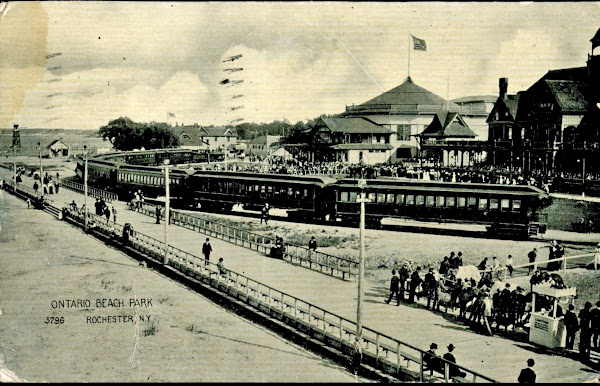
The picture on the front of this post card clearly demonstrates that a train used to bring visitors to the Ontario Beach Park in Rochester, New York. I have spent many hours on the internet searching for information about which railroad is shown on the front of this post card. I have come up completely empty handed. I did find a modern map that includes a rail line that travels east toward the southern part of the park, then turns south to follow the Genessee River into the city. There is no label on the map to tell us which railroad that is today.What makes matters worse for me is that there is no indication as to who the printer or publisher of the post card is.
There seems to be a hint nestled in the letter "C" in Post Card. It is either a bee or a wasp. This could be the logo of a company. But, I don't know. I am frustrated, but not enough to not share the picture on this post card and the back of it with you.

Wednesday, January 31, 2024

Operation Lifesaver Would NOT Be Happy

Operation Lifesaver, Inc. (OLI) [websites: https://oli.org/ in the USA and https://www.operationlifesaver.ca/ in Canada] is a non-profit organization and recognized leader of rail safety education. Since 1972, OLI remains committed to preventing collisions, injuries and fatalities on and around railroad tracks and highway-rail grade crossings, with the support of public education programs in states across the U.S. In 1981 this organization started “a sister” organization in Canada. As you can understand from the description above, Operation Lifesaver would not be happy with the people pictured on the front of this post card.
The people are sitting on the right of way of the Erie Railroad across Kinzua Creek in McKean County in Pennsylvania. The railroad decided to build the bridge rather than construct an additional eight miles of track. The trains that crossed the bridge carried coal and timber. The original bridge took forty workers took a mere 94 days to build the 2,053 foot long bridge. It was opened for traffic in 1882 and was hailed by the railroad and the construction crew as the Eighth Wonder of the World. However, the Eighth Wonder soon (12 years later) had to be rebuilt due to the heavier and heavier loads the steam locomotives were carrying across it. The bridge was rebuilt using steel, and reopened for use on September 25, 1900. During the bridge’s reconstruction many changes and adaptations were made; the bridge’s reconstruction took approximately 120 men about four months to complete. The commercial trains continued to use the bridge until the late 1950s. The bridge became the show piece of a State Park when Pennsylvania bought the bridge. Then, in 1987 the Knox and Kane Railroad began running tourist excursion trains across the bridge. In late June 2002, the bridge was closed to tourist trains. Two months later, pedestrians were no longer allowed to walk across the viaduct. It was decided to rehabilitate the bridge. In 2003, the bridge, while in the midst of the rehabilitation, was struck by a tornado. A large portion of it collapsed, rendering the bridge impassible. Today part of the bridge remains and tourists can use that part as a lookout while in the state park. This post card was published by the C.S. Woolworth & Co. out of Bradford, Pennsylvania. This information was found in Wikipedia: Its founder, Charles Sumner Woolworth (August 1, 1856 – January 7, 1947), was an American entrepreneur who went by the nickname of "Sum", opened and managed the world's first five-and-dime store in Scranton, Pennsylvania, and was founder of the "C. S. Woolworth & Co" chain of 5¢ & 10¢ stores. Sum's brother, Frank Winfield Woolworth was first to venture into the retail business with his own store, and soon after, he asked Sum to join him. Frank founded "F. W. Woolworth & Co", which later merged with other Woolworth affiliate stores to be the F. W. Woolworth Company. After the death of his brother, Sum became the longest serving Chairman of the F. W. Woolworth Company. In 1904, Sum and Frank Woolworth were affiliated with six (6) chains. Frank developed the back office side of the business. Sum developed the front of the business, pioneering self-service methods, customer service, training new managers, brightly lit stores, and frequently-changed window displays to lure customers inside. In 1912 C. S. Woolworth & Co, with the other affiliated chains, merged 596 stores under the corporate name "F. W. Woolworth Company". After the death of his brother, Charles became the reluctant Chairman of the Board of F. W. Woolworth Company (now Foot Locker), for 25 years.
This post card was published by the C.S. Woolworth & Co. out of Bradford, Pennsylvania. This information was found in Wikipedia: Its founder, Charles Sumner Woolworth (August 1, 1856 – January 7, 1947), was an American entrepreneur who went by the nickname of "Sum", opened and managed the world's first five-and-dime store in Scranton, Pennsylvania, and was founder of the "C. S. Woolworth & Co" chain of 5¢ & 10¢ stores. Sum's brother, Frank Winfield Woolworth was first to venture into the retail business with his own store, and soon after, he asked Sum to join him. Frank founded "F. W. Woolworth & Co", which later merged with other Woolworth affiliate stores to be the F. W. Woolworth Company. After the death of his brother, Sum became the longest serving Chairman of the F. W. Woolworth Company. In 1904, Sum and Frank Woolworth were affiliated with six (6) chains. Frank developed the back office side of the business. Sum developed the front of the business, pioneering self-service methods, customer service, training new managers, brightly lit stores, and frequently-changed window displays to lure customers inside. In 1912 C. S. Woolworth & Co, with the other affiliated chains, merged 596 stores under the corporate name "F. W. Woolworth Company". After the death of his brother, Charles became the reluctant Chairman of the Board of F. W. Woolworth Company (now Foot Locker), for 25 years.
In the bottom left-hand corner of the post card there is a symbol that tells us that another company had a hand in the printing and publishing of this card. The Samuel Langdorf & Co. has their logo there. Although the post card was printed in Germany, it was this company that made the connections that allowed the C.S. Woolworth & Co. to sell this post card in their store. The Samuel Langdorf & Co. published black & white and elaborately tinted halftone postcards. They are most noted for their cards with highly decorative borders incorporating motifs such as alligators. They existed from 1906 to 1918 in New York City.

Wednesday, January 24, 2024

The Northern Pacific Railway through the Years

The locomotive in the picture on the front of the top post card is that of the very first locomotive of the Northern Pacific Railway. It is the “famous” Minnetonka. It was built in 1870 and used in construction work in Minnesota in 1870 and 1871. It was then shipped to San Francisco by rail and by steamer to the Columbia River for construction service on the west end of the Northern Pacific’s rail line from Kalama to Tacoma, Washington. It weighed 12 tons and cost $6,700 (about $150,000 in today’s dollars).
The front of the middle post card contains a picture of Northern Pacific’s Locomotive Number 13. It was a 4-4-0 “American”-type locomotive. It was built by Schenectady Locomotive Works (long before it was merged into the American Locomotive Company [Alco] in 1901). Four of them (numbers 13 through 16) were built for the Northern Pacific Railway. All four locomotives were still operating in 1935, but soon after they were all scrapped. These two post cards were published by Bob Fremming out of Dallas, Wisconsin. My guess is that they were published in March of 1957 – there is a code in the top-middle of the post card that says, “3-57”.
This third post card has a much more modern steam locomotive picture. It is a 4-8-4 Northern-type of locomotive. It was built by Baldwin in 1943. It was not the first Northern-type locomotive built for the Northern Pacific Railway. That was done by Alco in 1926. You can easily see that this is a coal-burning steam locomotive; just look at that load of coal in the tender!! The picture was part of the Carl H. Sturner Collection. Carl Sturner was the founder of Audio-Visual Designs for the sole purpose of sharing train related audio-visual materials to rail fans. The company is still operating today, but without Mr. Sturner, who died in 1995. This post card was published by Audio-Visual Designs after 1983 – there is a five digit zip code with the 4-digit extension in the address.

Wednesday, January 17, 2024

Definitely NOT Twins!!

The two locomotives in these two post cards belonged to the same railroad company: The New York Central Railroad Company. The top locomotive was built in 1926 by the American Locomotive Company in Schenectady, New York as one of 100 class L-2a Mohawk-type locomotives. Here it is at Harmon, New York in December of 1949. The bottom locomotive was also built by the American Locomotive Company. It was built eleven years later. In 1941 the locomotive was streamlined to match the Budd stainless steel passenger equipment that it was intended to pull for the “Empire State Express”.
Here is some history of the New York Central Railroad as found on this website: https://www.britannica.com/topic/New-York-Central-Railroad-Company New York Central Railroad Company, one of the major American railroads that connected the East Coast with the interior. Founded in 1853, it was a consolidation of 10 small railroads that paralleled the Erie Canal between Albany and Buffalo; the earliest was the Mohawk and Hudson, New York state’s first railway, which opened in 1831. Cornelius Vanderbilt joined it to the Lake Shore and Michigan Southern Railway in 1873, extending his system from Buffalo to Chicago. He added the Michigan Central in 1871. Under his son William, the Central acquired the New York, West Shore, and Buffalo Railroad on the west side of the Hudson River in 1885. The system grew until it had 10,000 miles (16,090 km) of track linking New York with Boston, Montreal, Chicago, and St. Louis. After World War II the New York Central began to decline. Between 1946 and 1958 it dropped four of its six fast daily passenger runs between New York and Chicago. Efforts to merge with its chief competitor, the also ailing Pennsylvania Railroad Company, culminated in 1968 with the creation of the Penn Central Transportation Company—a merger that later included the New York, New Haven and Hartford Railroad, in 1969. The new colossus had 21,000 miles (33,790 km) of track. The merger failed, however, and the new road was forced into bankruptcy in June 1970. Passenger services were taken over by the federally established National Railroad Passenger Corporation (Amtrak) in 1971. The company’s other railroad assets were merged with five other lines in Consolidated Rail Corporation (Conrail) in April 1976, although the New York–Washington route was later transferred to Amtrak. Both post cards are part of my 333 card collection of Audio-Visual Designs out of Earlton, New York. The were both published after 1963. They have the 5-digit zip code in their addresses.