Every post card in my collection has its own story. Every Wednesday I post one of the 3,000 plus stories.
Wednesday, March 8, 2023
The Louisville & Nashville in Florida?
If one takes out a magnifying glass and focuses on the dark line that forms the top of the tender in this picture, one can see the letters “L & N”. They are the reporting mark of the Louisville & Nashville Railroad.
The American Rails website gives us a glimpse into the history of the Louisville & Nashville Railroad (The Dixie Line). This website is full of historic information about many railroads. I have taken the information below from them: https://www.american-rails.com/nashville.html
The Louisville and Nashville Railroad served the heart of the Southeast from New Orleans and Memphis to Atlanta and the Florida Panhandle. the Louisville & Nashville Railroad was created on March 5, 1850 when the state of Kentucky issued a charter for the company "...to build a railroad between Louisville, Kentucky, and the Tennessee state line in the direction of Nashville." The L&N's first segment officially opened on August 25, 1855 and work proceeded quickly to push rails southward towards Tennessee. After four years of additional labor the railroad's charter was completed when it opened to Nashville on October 27, 1859. In 1881, it finally reached New Orleans via Mobile, Alabama via the Montgomery & Mobile and New Orleans, Mobile & Texas. Two years later, in 1883, it opened a 170-mile corridor from Pensacola to Chattahoochee, Florida, its furthest reach into Florida. It is this location to which the inscription on the smoke stack in the picture on the post card refers. “Pensacola, Florida Feb 1911”
It also extended to St. Louis and later reached Chicago. The L&N carries precedence as one of the few to maintain its originally chartered name, operating for more than 120 years as the Louisville & Nashville.
This post card is what we consider to be a “Real Photo” post card. The person took the photo then printed it on special paper. This particular post card was printed on AZO paper. Where the stamp goes has the corporate name plus, each corner has a diamond in it. The placement of these diamonds tells us that the post card was printed between 1907 and 1909.
Wednesday, March 1, 2023
Push-me, Pull-you
Turn the calendar back to November 8, 1954, go down to the river bank at Paxinos, Pennsylvania, and watch Pennsylvania Railroad’s train S-390 go by. In this picture the train is being pulled by Baldwin-built Decapod 4644. It is pulling 119 cars and two more Decapods (numbers 4629 and 4639) are pushing them.
Paxinos is Northumberland County, Pennsylvania about the middle of the eastern third of state. Paxinos, founded in 1769, was named for a Shawanee Native American chief. The town is known in the area for its music store, which has a distinctive mural of a guitar player. You can see the mural in the circle on the cover of their facebook page.
Today the Shamokin Valley Railroad has a station in Paxinos. This railroad has four interchanges with other railroads: Norfolk Southern Interchange, Canadian Pacific Interchange, the Reading Blue Mountain & Northern Interchange and the Lycoming Valley RR, North Shore RR, Union County Industrial RR Interchange.
It also has four other train stations in Sunbury, Weigh Scales, Shamokin, and Carbon Run Pennsylvania.
The post card is published by Audio-Visual Designs in Earlton, New York. It was published after October of 1983 because the Zip Code contains the 5-digit plus 4-digit identification system. I have 333 post cards published by Audio-Visual Designs; by far, this is the largest group in my collection.
Wednesday, February 22, 2023
You Can Still See It Today
The locomotive on display on the front of this post card is still in existence today. This was the first locomotive used to haul iron ore from the Iron Range to the ore docks at Two Harbors, Minnesota. The Duluth & Iron Range Railroad No. 3 is a 2-6-0 "Mogul" type steam locomotive built by the Baldwin locomotive works in 1883 for the Duluth & Iron Range Railroad.
It was intended for a railroad in Brazil at a cost of $12,000, but was refused on technical grounds and needing a locomotive to help lay rails from Two Harbors, MN., the D&IR purchased it for $9,750.
The locomotive was shipped to Two Harbors by barge and was the only wood burning locomotive ever operated on the road. It was a good choice, however, because it could take fuel from the plentiful adjacent forests, and water from the many local rivers and streams as it hauled rails, supplies and equipment from Agate Bay up to the rail head.
The locomotive was assigned to the Minnesota Iron Company in 1874, where it hauled iron ore from its Soudan mine to Two Harbors, and the company greatly contributed to the growth of the town.
It was bought by Illinois Steel in 1887 which, in 1901, became part of United States Steel Corporation. The D&IR then merged into the Duluth Missabe & Iron Range in 1938.
As heavier locomotives arrived on the D&IR, "3 Spot" was beginning to seem unsuited for the longer trains. Surplus to requirements, it was sold to the Duluth & Northern Minnesota, another ore carrier operating out of the Missabe Range to docks at Superior, WI, and Duluth, MN, in 1899 and was renumbered #2.
Today the locomotive is on static display at the Two Harbors Depot Museum in Two Harbors, MN.
The psot card was printed by W. A. Fisher Company of Virginia, Minnesota. Founded in 1922 in Virginia, MN, the W.A. Fisher Company broke into the business world as a printer and lithographer – one of the first north of the Twin Cities. Although the company has since expanded to include advertising, marketing and interactive divisions, full service printing and binding remains as one of our core capabilities. Over our many years in business, W.A. Fisher Printing has built a reputation for quality and outstanding customer service.
Wednesday, February 15, 2023
Forerunner of the Burlington Northern Santa Fe Railroad
The locomotive on the front of this post card is part of Northern Pacific Railway's First North Coast Limited, shortly after the train was put into service in April of 1900. The North Coast Limited was a named passenger train operated by the Northern Pacific Railway between Chicago and Seattle via Bismarck, North Dakota. It started on April 29, 1900, and continued as a Burlington Northern Railroad train after the merger on March 2, 1970 with Great Northern Railway and the Chicago, Burlington and Quincy Railroad. The next year, it ceased operations after the trains which left their originating stations on April 30, 1971, the day before Amtrak began service (May 1, 1971), arrived at their destinations.
Our good friends at Wikipedia provide this short history of the Northern Pacific Railway as well as the details above about the North Coast Limited. The Northern Pacific Railway (reporting mark NP) was a transcontinental railroad that operated across the northern tier of the western United States, from Minnesota to the Pacific Northwest. Congress chartered the Northern Pacific Railway Company on July 2, 1864, with the goals of connecting the Great Lakes with Puget Sound on the Pacific, opening vast new lands for farming, ranching, lumbering and mining, and linking Washington and Oregon to the rest of the country. It was given nearly forty million acres (62,000 sq mi; 160,000 km2) of land grants, which it used to raise money in Europe for construction.
Construction began in 1870 and the main line opened all the way from the Great Lakes to the Pacific when former President Ulysses S. Grant drove in the final "golden spike" in western Montana on September 8, 1883. The Northern Pacific was headquartered in Minnesota, first in Brainerd, then in Saint Paul. It had a tumultuous financial history; the NP merged with other lines in 1970 to form the Burlington Northern Railroad, which in turn merged with the Santa Fe to become the BNSF Railway in 1996.
I have posted other post cards by the publisher of this one: Bob Fremming of Dallas, Wisconsin. I cannot find much information about him on line, but he was a prolific publisher. There are samples of his cards on line at Etsy, Ebay, and other auction sites.
Wednesday, February 8, 2023
Everyone Wants to Get into the Act
The first 4-8-4 engine was built in 1927. There were 1,126 engines owned by 36 railroads in North America. The locomotive on the front of this post card is 4-8-4 “Northern” type engine. It had 70 inch drivers and weighed 494,000 pounds. This locomotive is part of a publicity shot by the Norfolk & Western Railway in the 1940s at its Roanoke shops in Virginia; as you can see, everyone wanted to get into the act. The following information was taken from this website: https://www.nwhs.org/about_nw.php
The Norfolk & Western Railway was a unique operation of modest proportions that achieved recognition beyond contemporary railroads of similar size. In actuality, Norfolk & Western had two differing styles. Before 1964, it was a coal hauler known for its excellent financial performance, and which operated arguably the finest fleet of steam motive power at the head of long coal trains. The routine tonnage carried on these trains would be considered records elsewhere. Changes began first with dieselization and then merger with Virginian Railway in the late 1950's. In 1964 Norfolk & Western leased, merged with, or purchased several other railroads to expand its operation becoming a major midwestern carrier. As such it operated routes from Norfolk VA and Buffalo NY to Chicago IL and St. Louis and Kansas City MO. On June 1, 1982 the Norfolk & Western, along with the Southern Railway, became subsidiaries of Norfolk Southern Corporation, a newly formed holding company. Finally on September 1, 1998 Norfolk & Western's corporate existence ended as it was merged into Norfolk Southern Corporation.
The post card was published by the Mayer Post Card Company. Its address was 2234 Maiden Lane, S. W., Roanoke, Virginia. There is a zip code as part of the address (24015) so this post card was published after 1963, even though the picture is from the 1940s. I was searching for this company on the internet. Here is what I found at https://whereorg.com/mayer-post-card-co-17506845 According to our records, this business is located at 3633 Ghent Dr. in Chesterfield (in Chesterfield County), Virginia 23832, the location GPS coordinates are: 37.459198 (latitude), -77.519507 (longitude). Mayer Post Card Co is categorized under Sales and Receipt Books (SIC code 5112). Known organization owner is Christopher Mayer. Current estimates show that the unit has a sales volume of $342,000 and staff of approximately 1 worker. You can contact the company by phone at (804) 276-7373.
Wednesday, February 1, 2023
Another Nickel Plate Locomotive
The locomotive pictured on the front of this post card was built by Lima in 1944 – very close to the end of the steam era of railroads. Here it is viewed near Sheldon, Illinois on May 7, 1980 with a freight train of the Toledo, Peoria & Western. It picked up the consist in Effner, Indiana and it is bound for East Peoria, Illinois. But, this is no regular revenue run. This locomotive has been restored. It was on static display and is now operable. Read on…the information below was taken from this website: https://fortwaynerailroad.org/about/
The Fort Wayne Railroad Historical Society, Inc. (FWRHS) is an award-winning, 501(c)3 non-profit corporation founded in 1972. The organization has over 800 members, 100 volunteers, nine board of directors and a number of project managers. In 1974, the Society was successful in removing historic Nickel Plate Road steam locomotive no. 765 from display in Lawton Part in Fort Wayne, Indiana. That is the locomotive whose photo appears on the front of this post card. In 1979, the FWRHS became the first all volunteer, non-profit organization to successfully restore and operate a steam locomotive, writing a significant chapter in the early days of the country’s rail preservation movement. Since 1980, the Society has hosted and administered passenger train excursions, private charters, public exhibitions and education outreach activities with the 765 and a variety of other vintage railroad equipment throughout the Midwest. The locomotive and its train continue to serve as an uncommon cultural attraction with worldwide appeal, offering tourists, passengers and supporters from all 50 states and numerous countries the opportunity to relive a bygone era of innovation in American history. The Society holds regular work sessions and open houses at its restoration facility in New Haven, Indiana during the year and is poised to become a major player in downtown Fort Wayne as part of the Headwaters Junction attraction – all within a mile of the park where the 765 was initially preserved for display.
The post card was published by Mary Jayne’s Railroad Specialties, Inc. I have written about Mary Jayne in the past. I never get tired of telling people what a great correspondence I had with her when I was trying to see if she printed a catalogue of the train post cards that she published. She did; and she sent it to me for free! She only asked that I give some money to charity or to my church. The picture on the front was taken by Russ Porter. My research tells me that he was born on November 5, 1918 and died on October 24, 2001. He was a prolific railroad photographer.
Wednesday, January 25, 2023
Chicago to New York in Style
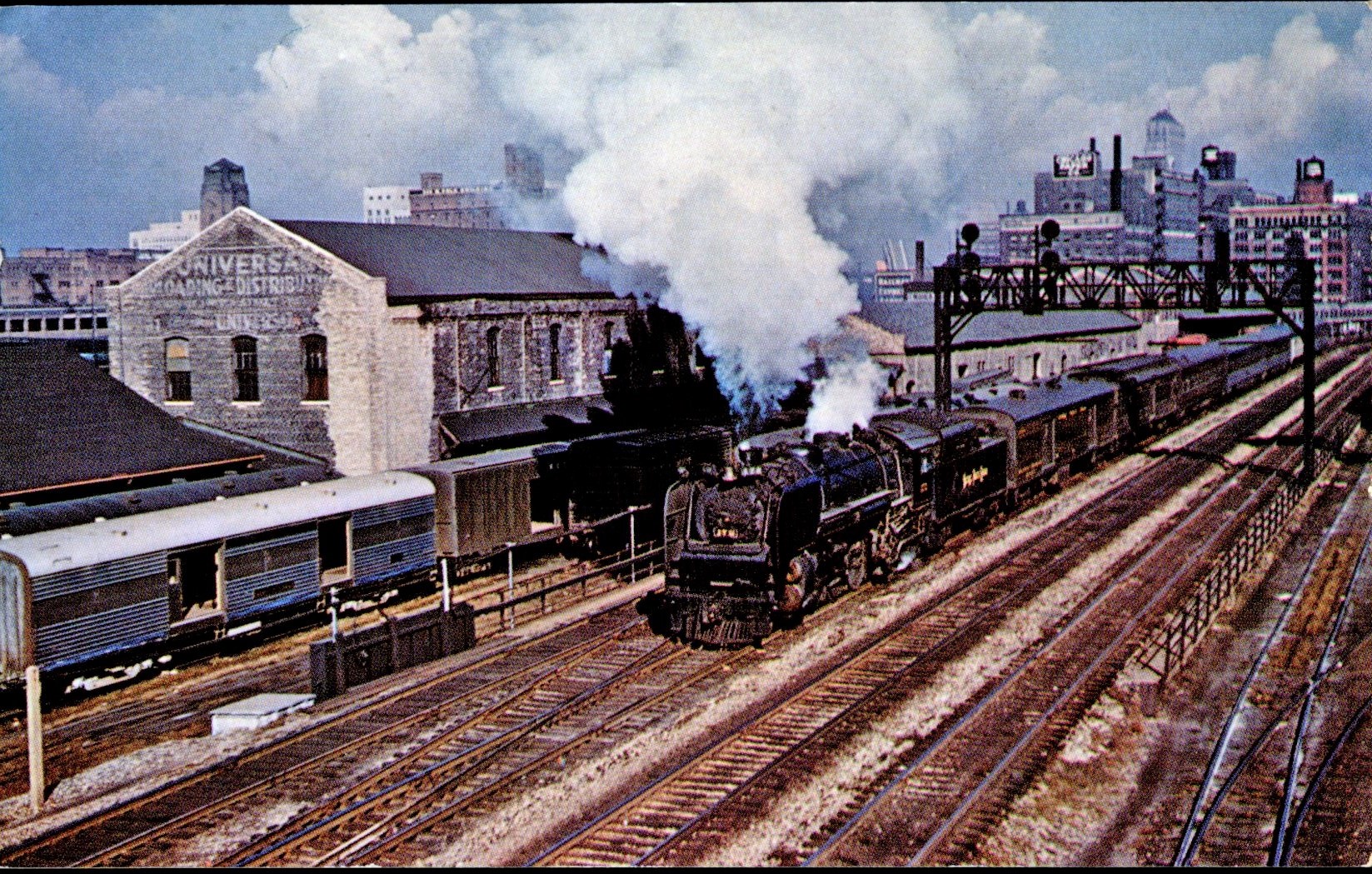
The locomotive in the picture on the front of this post card is Nickel Plate Number 172. It is pulling train Number 8 from Chicago to New York. It is departing Chicago here on October 14, 1955.
The following information was taken from these two websites: https://en.wikipedia.org/wiki/Nickel_Plate_Road and https://www.american-rails.com/nickel.html
Its 2,200-mile network linked Buffalo with Chicago and St. Louis within the hotly contested Midwestern market while the late-era addition of the Wheeling & Lake Erie provided significant coal and steel traffic. It was built to impeccably high standards with a physical plant capable of high-speed service that shined in the post-World War II era. As a result, all three trunk lines (Pennsylvania, New York Central, and Baltimore & Ohio) occasionally shifted their own trains (including flagship services) onto the Nickel Plate. It did so well, in fact, that according to John Rehor's excellent book, "The Nickel Plate Story," the company grossed $2.8 billion between 1945 and the 1964 merger with Norfolk & Western while enjoying profits of $250 million. Today, many of the Nickel Plate's primary corridors remain in use under successor Norfolk Southern.
The Nickel Plate Limited was a passenger night train operated by the New York, Chicago and St. Louis Railroad (Nickel Plate) between Chicago and Buffalo, New York via Cleveland, Ohio, with through service to Hoboken, New Jersey (for New York City) via Binghamton and Scranton and the Delaware, Lackawanna and Western Railroad for the Buffalo-Hoboken segment. In 1954 the Nickel Plate renamed the train: the westbound train became the City of Chicago while the eastbound train became the City of Cleveland. Service to Hoboken ended in 1959. Both trains survived the Nickel Plate itself: service ended on September 10, 1965, a year after the Nickel Plate's 1964 merger with the Norfolk and Western Railway. They were the final remnants of the Nickel Plate's passenger service.
This post card was published by Audio-Visual Designs our of Earlton, New York. It was published between 1955 and 1963. I know this because the picture was taken in 1955 and the address of Audio-Vidual Designs does not include a zip code. Zip codes were introduced in the United States in 1963.
Subscribe to:
Posts (Atom)