Colette and I won a trip to Los Angeles through a radio station that we listen to and support. We stayed in a hotel in the financial district about 6 or 8 blocks from the Union Train Station. Just a few blocks away from our hotel was an even more famous (with me, at least) railway station: Angels Flight Railway. When I was much younger… in the 1960s …our family went to the Angels Flight Railway and rode the funicular. I don’t remember how many times we went up and down Bunker Hill. It was great. I still have a ticket to ride Angels Flight from that time in my box of memorabilia. Originally, I kept it because I thought that we would someday return and ride it again. I didn’t know much about the railroad then. But, to date I have found lots of very interesting background and information.
Angels Flight was the result of the efforts of Colonel James Ward Eddy, a Civil War veteran. He began construction of Angels Flight (a two foot, six inch gauge railroad) on August 2, 1901. The railway ended up being a 33 percent grade for 315 feet. He opened the railway on December 31st of the same year. On Opening Day more than 2,000 people took the two funicular cars, Olivet and Sinai, between Hill and Olive Streets (two blocks) in downtown Los Angeles.Colonel Eddy was born on May 30, 1832 in Java, New York and he died in Los Angeles on April 13, 1916. He moved to Illinois in 1853 where he studied law and became a lawyer and friend of Abraham Lincoln, so much so, that during the Civil War he enlisted in the Army and joined those whose job it was to protect Washington, D. C. After the war, he helped to build a branch line from Flagstaff, Arizona to Phoenix for the Santa Fe railroad. Then, he moved to Los Angeles in 1895. He was part of the project to bring power lines from the Kern River to L.A.
Six years after moving to Los Angeles, he built Angels Flight with his own money. It just so happens that this railway is very close to the area of town in which the colonel lived. The first rides cost one penny and they took passengers from one station to the next in about a minute.
In May of 1969 Angels Flight was closed down so the city government could redevelop the area and displace over 20,000 people. They put Angels Flight into storage. On February 24, 1996 Angels Flight was opened half a block south of the original site. Since then it has had several accidents and many safety violations. Today, it sits on display for all to see and none to ride.
You can get more information about Angels Flight on Wikipedia (http://en.wikipedia.org/wiki/Angels_Flight)or at http://www.ladowntownnews.com/news/will-angels-flight-ever-roll-again/article_f99ee604-bc49-11e3-abe6-0019bb2963f4.html or at http://www.picturetrail.com/sfx/album/view/23044083
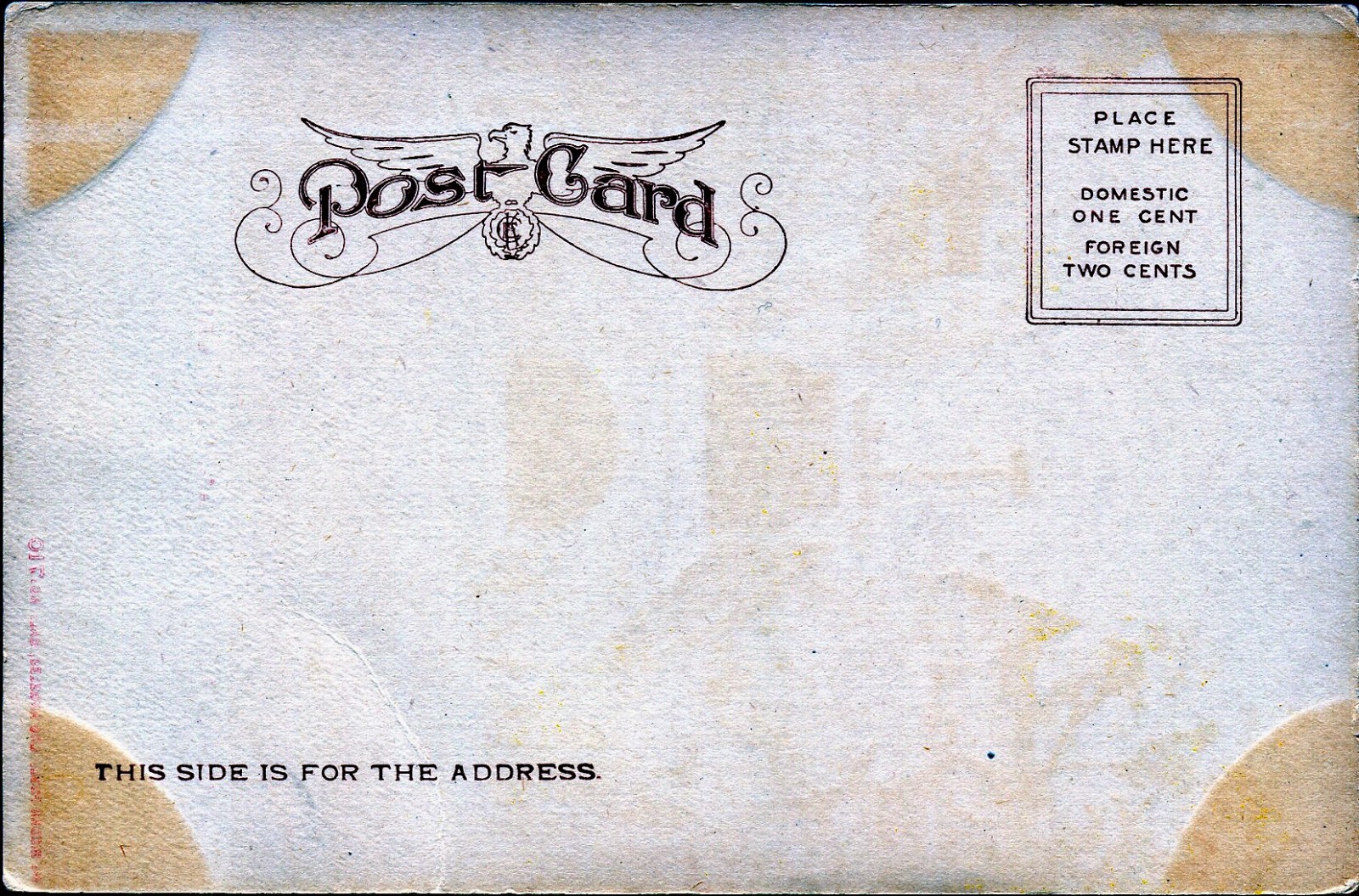
These two post cards show Angels Flight in its early years. Both post cards are from before March 1, 1907. The backs of them clearly show that one can only write the address on that side. The one on the left, above, is by the Detroit Publishing Co. There is a great source of information about the Detroit Company at (http://www.thehenryford.org/exhibits/dpc/how/animas3.asp and at http://www.metropostcard.com/publishersd.html The right-hand one is published by the M. Rieder Company who published view-cards of the West and of Native Americans. His cards were printed in Germany except those contracted out to Edward H. Mitchell in the United States.
The left one below is also from Detroit Publishing and the right-hand one is from M. Rieder.
Every post card in my collection has its own story. Every Wednesday I post one of the 3,000 plus stories.
Showing posts with label Detroit Publishing. Show all posts
Saturday, September 19, 2015
Saturday, May 23, 2015
Johnson's Canyon Bridge is NO MORE!
This is a post card of a steam engine pulling a passenger train over a bridge and into a tunnel as it crosses Johnson's Canyon in Arizona. The following information has been taken from the following presentation:
The Johnson Canyon Abandoned Railroad Grade: A History of 9.3 Miles of Treacherous Railroading in Northern Arizona By Neil S. Weintraub Northern Arizona University
Paper Presented at the 1993 Arizona History Conference in Kingman, Arizona
Johnson Canyon that is approximately eight miles west of Williams, Arizona, which is 81 miles west of Flagstaff. It is on the southwestern edge of the Colorado Plateau, a large geological uplift the forms an 1100 foot drop that plagued engineers as they built the tunnel and bridges over the canyon and through the rock. Congress chartered the Atlantic and Pacific Railroad Company to build a railway from Springfield, Missouri to San Diego, California. However, bankruptcy problems prevented the A&P from building the line until the Atchison, Topeka and Santa Fe Railroad Company acquired half interest, using the A&P charter to complete the line from Albuquerque to the Colorado River. It was in the summer of 1880 that the railroad reached the eastern Arizona border. Opening the line through Johnson Canyon required the construction of two steel bridges and a tunnel. This was the only segment of railroad grade in Arizona that required two bridges in any one locale, as well as necessitating the only tunnel west of Albuquerque. In early 1881, the A&P awarded a contract for all the work through the canyon to James T. Simms. By April, Simms’ track crews began feverishly grading the main line path by blasting rock cuts, building bridges, clearing trees, and cutting ties. Because of the significant labor the structures required, Simms’ construction camp
housed 2500-3000 men. The bridges were located just west of the tunnel and stood 100 feet above the canyon
bottom, spanning 330 feet and 360 feet. Working on the bridges was a precarious job. The bridges were trestle type. The first bridge consisted of eleven 30 foot girder spans resting on metal trestle bents on small masonry piers. The second bridge had twelve 30 foot girder spans supported by small masonry piers. In both cases, the Edge Moore Iron Works of Edge Moore, Delaware fabricated the metal. The Arizona line’s high maintenance costs proved financially disastrous, and in 1896 the AT&SF acquired the full ownership of the A&P. Few changes were made to the line until 1901 when the AT&SF upgraded the tunnel by having it lined with cement, roofed with steel plating and the portals faced with sandstone masonry. These modifications greatly reduced maintenance costs and the operations continued through the canyon until 1910. As technology advanced, newer, more powerful and heavier trains required gentler uphill grades. In 1910, the AT&SF built the first major realignment around Johnson Canyon to lessen the grade for eastward (uphill) bound trains. This line ran from just west of Fairview to two miles east of McLellan, passing north of Johnson Canyon. Although construction lengthened this segment from 9.3 miles to 12.7 miles, it reduced uphill grades from 112 feet per mile to 82 feet per mile. by 1960, spurred by the need for higher clearances, the Santa Fe commenced work on a new multi-million dollar realignment that bypassed the 1882 Johnson Canyon railroad grade and the 1910 realignment. With the new realignment, crews scrapped the rails in Johnson Canyon and the ties left to rot. Here is a picture, I found on the internet, of Johnson's Canyon today: The post card was published by Fred Harvey. My blog post of February 7, 2014 explains much about Mr. Harvey and his chain of restaurants. Harvey began a business venture of setting up restaurants along the Kansas Pacific Railroad with Jeff Rice in 1873. It didn’t survive; but, Fred realized that this was to be his life’s work. 1876 he struck a deal with an acquaintance, Charles Morse. Harvey opened eating houses rent free along the Atchison, Topeka and Santa Fe Railroad – of which Mr.Morse was the superintendent. The deal was sealed only with a handshake, but it would have huge ramifications for both parties. At its peak, there were 84 Harvey Houses, all of which catered to wealthy and middle-class visitors alike and Harvey becameknown as "the Civilizer of the West."
The Johnson Canyon Abandoned Railroad Grade: A History of 9.3 Miles of Treacherous Railroading in Northern Arizona By Neil S. Weintraub Northern Arizona University
Paper Presented at the 1993 Arizona History Conference in Kingman, Arizona
Johnson Canyon that is approximately eight miles west of Williams, Arizona, which is 81 miles west of Flagstaff. It is on the southwestern edge of the Colorado Plateau, a large geological uplift the forms an 1100 foot drop that plagued engineers as they built the tunnel and bridges over the canyon and through the rock. Congress chartered the Atlantic and Pacific Railroad Company to build a railway from Springfield, Missouri to San Diego, California. However, bankruptcy problems prevented the A&P from building the line until the Atchison, Topeka and Santa Fe Railroad Company acquired half interest, using the A&P charter to complete the line from Albuquerque to the Colorado River. It was in the summer of 1880 that the railroad reached the eastern Arizona border. Opening the line through Johnson Canyon required the construction of two steel bridges and a tunnel. This was the only segment of railroad grade in Arizona that required two bridges in any one locale, as well as necessitating the only tunnel west of Albuquerque. In early 1881, the A&P awarded a contract for all the work through the canyon to James T. Simms. By April, Simms’ track crews began feverishly grading the main line path by blasting rock cuts, building bridges, clearing trees, and cutting ties. Because of the significant labor the structures required, Simms’ construction camp
housed 2500-3000 men. The bridges were located just west of the tunnel and stood 100 feet above the canyon
bottom, spanning 330 feet and 360 feet. Working on the bridges was a precarious job. The bridges were trestle type. The first bridge consisted of eleven 30 foot girder spans resting on metal trestle bents on small masonry piers. The second bridge had twelve 30 foot girder spans supported by small masonry piers. In both cases, the Edge Moore Iron Works of Edge Moore, Delaware fabricated the metal. The Arizona line’s high maintenance costs proved financially disastrous, and in 1896 the AT&SF acquired the full ownership of the A&P. Few changes were made to the line until 1901 when the AT&SF upgraded the tunnel by having it lined with cement, roofed with steel plating and the portals faced with sandstone masonry. These modifications greatly reduced maintenance costs and the operations continued through the canyon until 1910. As technology advanced, newer, more powerful and heavier trains required gentler uphill grades. In 1910, the AT&SF built the first major realignment around Johnson Canyon to lessen the grade for eastward (uphill) bound trains. This line ran from just west of Fairview to two miles east of McLellan, passing north of Johnson Canyon. Although construction lengthened this segment from 9.3 miles to 12.7 miles, it reduced uphill grades from 112 feet per mile to 82 feet per mile. by 1960, spurred by the need for higher clearances, the Santa Fe commenced work on a new multi-million dollar realignment that bypassed the 1882 Johnson Canyon railroad grade and the 1910 realignment. With the new realignment, crews scrapped the rails in Johnson Canyon and the ties left to rot. Here is a picture, I found on the internet, of Johnson's Canyon today: The post card was published by Fred Harvey. My blog post of February 7, 2014 explains much about Mr. Harvey and his chain of restaurants. Harvey began a business venture of setting up restaurants along the Kansas Pacific Railroad with Jeff Rice in 1873. It didn’t survive; but, Fred realized that this was to be his life’s work. 1876 he struck a deal with an acquaintance, Charles Morse. Harvey opened eating houses rent free along the Atchison, Topeka and Santa Fe Railroad – of which Mr.Morse was the superintendent. The deal was sealed only with a handshake, but it would have huge ramifications for both parties. At its peak, there were 84 Harvey Houses, all of which catered to wealthy and middle-class visitors alike and Harvey becameknown as "the Civilizer of the West."
Subscribe to:
Posts (Atom)


